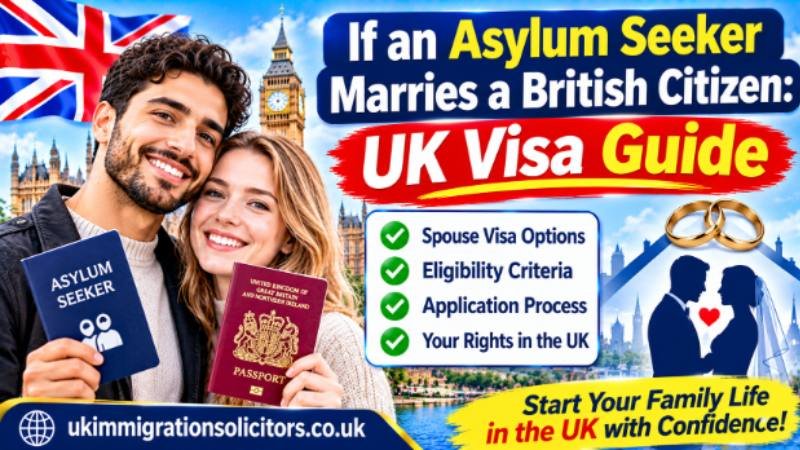
Marriage can create important family and immigration considerations for someone seeking protection in the UK. Many people want to understand if an asylum seeker marry a british citizen and whether marriage can provide another way to remain in Britain. Although marrying a British citizen may make a family immigration application possible in certain circumstances, it does not automatically grant permission to stay or cancel an existing asylum claim. The applicant must meet the relevant immigration requirements, and their current status can significantly affect their options. Understanding the relationship between asylum applications, spouse visas and UK immigration rules is essential before making any important decisions.
Can an Asylum Seeker Marry a British Citizen in the UK?
Yes. An asylum seeker can potentially marry a British citizen in the UK, provided the legal requirements for marriage are satisfied.
Being involved in an asylum application does not automatically prevent someone from entering a genuine relationship or getting married.
However, marriages involving people who are subject to immigration control may be referred to the Home Office under the marriage and civil partnership referral scheme.
Depending on the circumstances, the Home Office may investigate whether the proposed marriage is genuine or intended to circumvent immigration rules.
If the Home Office has reasonable grounds to suspect a sham marriage, the notice period can be extended from 28 days to 70 days.
This does not mean every marriage involving an asylum seeker is suspicious. Genuine couples should provide accurate information and follow the registration requirements.
Does Marriage Give an Asylum Seeker the Right to Stay in Britain?
No. Marriage to a British citizen does not automatically provide immigration permission.
This is one of the most important points couples should understand before making decisions about their future.
A marriage certificate can provide evidence of a genuine relationship, but it does not replace the requirement to obtain appropriate immigration permission.
The applicant must consider:
- Their current asylum application status.
- Whether they have immigration bail or another form of permission.
- Whether they can apply under the family immigration rules.
- Whether they meet the financial requirements.
- Whether their relationship satisfies the relevant eligibility conditions.
- Whether human rights considerations apply.
A person with a pending asylum application may face different restrictions from someone who has already received refugee status or another form of permission to remain.
Can an Asylum Seeker Apply for a Spouse Visa After Marriage?
The answer depends on the person’s immigration circumstances.
The UK spouse visa route allows eligible foreign nationals to live with their British or settled partners, provided they satisfy the relevant requirements.
However, someone with a pending asylum claim should not assume that getting married automatically makes them eligible to switch into the standard five-year spouse visa route from inside the UK.
Many people with pending asylum claims are on immigration bail, which can restrict in-country family visa applications.
The relevant immigration rules and any applicable exceptions must be examined carefully.
What If the Asylum Application Is Still Pending?
If the Home Office has not made a final decision on an asylum application, the individual should obtain legal advice before making changes to their immigration position.
Important considerations include:
- Whether the asylum applicant is currently on immigration bail.
- Whether they have any separate permission to remain.
- Whether an in-country partner application is legally available.
- Whether an exceptional family or human rights application may be appropriate.
- How a new application could affect the existing asylum proceedings.
An asylum seeker should not withdraw their protection claim simply because they have married a British citizen.
The asylum claim and family immigration application are separate legal matters. Each requires its own assessment.
What If the Person Has Already Received Refugee Status?
The situation may be different if the Home Office has already granted refugee status or humanitarian protection.
A person with protection status may be able to apply under the relevant family immigration route if their British citizen partner meets the sponsor requirements.
The correct application route will depend on their current permission, relationship circumstances and the applicable rules.
It is important to distinguish between someone waiting for an asylum decision and someone who has already received protection status.
Can an Asylum Seeker Apply From Outside the UK?
Some family visa applicants must apply from outside Britain.
However, leaving the UK while an asylum claim is pending can have serious consequences.
Departure may result in the asylum claim being treated as withdrawn, and returning to the country from which protection was sought may create additional risks.
Applicants should never make travel arrangements or withdraw a protection claim without understanding the legal consequences.
UK Spouse Visa Requirements for Couples
For eligible applicants, the UK Spouse Visa route provides a way to live with a British citizen or another qualifying sponsor.
Both partners must normally be at least 18 years old and intend to live together permanently in the UK.
The applicant must demonstrate that their relationship meets the relevant requirements.
Genuine Relationship Evidence
The Home Office needs to establish that the relationship is genuine and continuing.
Evidence may include:
- Marriage or civil partnership certificates.
- Joint tenancy agreements.
- Shared bank statements.
- Household bills.
- Photographs from family events.
- Communication records.
- Evidence of financial support.
- Documents showing shared responsibilities.
The type of evidence required depends on the circumstances.
A marriage certificate is important, but additional documentation may be necessary to demonstrate the nature of the relationship.
Financial Requirements
Applicants must also satisfy the applicable financial requirements.
For most new partner applications made under the standard rules since 11 April 2024, the minimum income requirement is £29,000 per year.
However, different provisions may apply to people who applied successfully under earlier rules or whose sponsor receives certain qualifying disability or carer benefits.
Applicants should check the requirements applicable to their particular application rather than assuming the same threshold applies to everyone.
English Language Requirements
Applicants may need to demonstrate their English language ability through an approved qualification or another accepted method.
Exemptions may apply depending on nationality, age or personal circumstances.
The requirements can differ between an initial application and later extensions or settlement applications.
How UK Immigration Solicitors Can Help
UK immigration applications can become complicated when an applicant has a previous refusal, an unresolved asylum claim or a complex relationship history.
Professional legal assistance can help couples understand which immigration route may be available and what evidence they need.
UK Immigration Solicitors provides assistance with personal and business immigration matters, including family applications, settlement, citizenship and immigration refusals.
UK Immigration Solicitors London
People looking for UK immigration solicitors London may need help with spouse visas, fiancé applications, asylum-related family matters or indefinite leave to remain.
London has a diverse international population, and many couples face immigration questions when one partner is British and the other has a different immigration status.
A legal assessment can help identify potential problems before an application is submitted.
UK Immigration Solicitors Birmingham
UK immigration solicitors Birmingham can assist individuals and families who need guidance with family visas, work applications, settlement and previous immigration refusals.
For example, someone living in Birmingham who has married a British citizen may need to establish whether their current immigration status allows an in-country family application.
Understanding this before submitting an application can help avoid unnecessary complications.
UK Immigration Solicitors Manchester
People searching for UK immigration solicitors Manchester may also need support with asylum-related immigration issues, partner applications and long-term residence.
Manchester has a large international community, and immigration advice can be important for individuals whose personal circumstances have changed while an application is being considered.
The firm also provides nationwide assistance, so people do not necessarily need to live close to one of its offices to discuss their immigration circumstances.
Understanding Leave to Remain in the UK
Leave to remain is permission granted to someone who is already in the UK to stay for a specified period or under an applicable immigration route.
It is different from indefinite leave to remain, which provides settlement without a time limit.
People may receive limited leave to remain through several immigration categories, including:
- Family and partner visas.
- Work-related immigration routes.
- Private life applications.
- Human rights applications.
- Certain protection-related routes.
The conditions attached to permission depend on the category under which it is granted.
How Can Someone Apply for Leave to Remain?
The application process depends on the person’s current immigration status and the reason they want to remain in Britain.
For example, a person applying through the family route may need to demonstrate a genuine relationship with a qualifying British or settled partner.
Someone applying through a human rights route may need to provide evidence of family life, private life or exceptional circumstances.
Applicants should identify the correct route before completing an application.
Leave to Remain for Family Reasons
Family life is an important consideration under UK immigration law.
A person may qualify for a family visa if their partner is a British citizen, settled in the UK or holds another qualifying immigration status.
However, being married to a British citizen does not automatically remove every immigration restriction.
The Home Office considers the applicant’s circumstances, relationship evidence, financial position and applicable immigration requirements.
Where the standard requirements cannot be met, certain applicants may still have options based on exceptional circumstances or human rights considerations.
Each application requires an individual assessment.
From Leave to Remain to Indefinite Leave to Remain
People who receive limited permission to stay may eventually become eligible for settlement.
Indefinite leave to remain, commonly called ILR, allows eligible individuals to live, work and study in the UK without a time limit on their immigration permission.
It is an important milestone for people who want to establish their permanent future in Britain.
However, the qualifying period depends on the immigration route.
Five-Year Settlement Route
Some family and work immigration categories provide a route to settlement after five qualifying years.
For example, eligible spouse visa holders may qualify after completing five continuous years on the relevant family route.
They must also meet the applicable relationship, financial, English language and other settlement requirements.
Ten-Year Settlement Route
Some people may qualify through the ten-year Long Residence route.
This route considers qualifying lawful residence across different eligible immigration categories.
However, not every type of immigration permission counts towards the qualifying period.
Applicants should review their immigration history and travel records before deciding which settlement route may apply.
What Happens After ILR Is Granted?
Once indefinite leave to remain is granted, the individual can generally live and work in Britain without needing further time-limited immigration extensions.
They may also become eligible to apply for British citizenship, subject to the separate naturalisation requirements.
ILR is therefore an important step for people who want long-term security and stability in the UK.
Documents Couples Should Prepare for Immigration Applications
Proper documentation is essential when applying for a family visa or another form of permission to remain.
Depending on the application, useful documents may include:
- Current passport and identity documents.
- Marriage or civil partnership certificate.
- Evidence of the British partner’s citizenship.
- Proof of shared accommodation.
- Financial and employment documents.
- Evidence of communication and relationship history.
- Previous immigration decisions.
- Asylum registration and Home Office correspondence.
- Details of any immigration bail conditions.
- Supporting evidence relating to children, where relevant.
Applicants should provide accurate information and disclose relevant immigration history.
Leaving out important information can create serious difficulties during the decision-making process.
Frequently Asked Questions
If an asylum seeker marries a British citizen, can they stay in the UK?
Not automatically. Marriage may support a family immigration application, but the individual must qualify under the relevant immigration rules or another applicable legal route.
Can an asylum seeker apply for a spouse visa in the UK?
It depends on their current immigration status. A pending asylum claim and immigration bail can restrict in-country applications under the standard partner route. Specific exceptions and human rights considerations may need to be examined.
Does marriage cancel an asylum application?
No. Marriage does not automatically cancel an asylum claim. The asylum process and any family immigration application are separate matters.
Can an asylum seeker work after marrying a British citizen?
Marriage itself does not grant permission to work. Employment rights depend on the person’s existing immigration permission or other applicable authorisation.
What is the difference between leave to remain and indefinite leave to remain?
Limited leave to remain provides permission for a specified period or under particular conditions. Indefinite leave to remain provides settlement without a time limit, subject to the applicable rules.
Can a person with refugee status apply for a spouse visa?
A person with refugee status may have access to the relevant family immigration route, depending on their circumstances and the current rules. Their partner’s eligibility and the appropriate application category should be checked.
How long does it take to obtain indefinite leave to remain?
The qualifying period depends on the immigration route. Some applicants may qualify after five years, while others may need to complete ten years or another applicable period.
Conclusion
Marrying a British citizen can create an opportunity to explore family immigration options, but it does not automatically give an asylum seeker the right to remain in the UK.
The individual’s current asylum status, immigration bail conditions, relationship evidence and eligibility under the family immigration rules must all be considered.
Understanding the difference between a spouse visa, limited leave to remain and indefinite leave to remain is equally important. Couples should obtain appropriate legal guidance before withdrawing an asylum claim, travelling abroad or submitting a new immigration application.
Careful preparation and an accurate understanding of UK immigration requirements can help couples make informed decisions about their relationship and their future in Britain.